
In March 2016, Lee Sedol sat down at a Go board in Seoul. He was one of the world's best players in a game with more possible positions than there are atoms in the universe. His opponent was AlphaGo, an algorithm from DeepMind. In the second game, the machine played a move that commentators first took to be a mistake. Professional players called it impossible. The machine won 4–1.
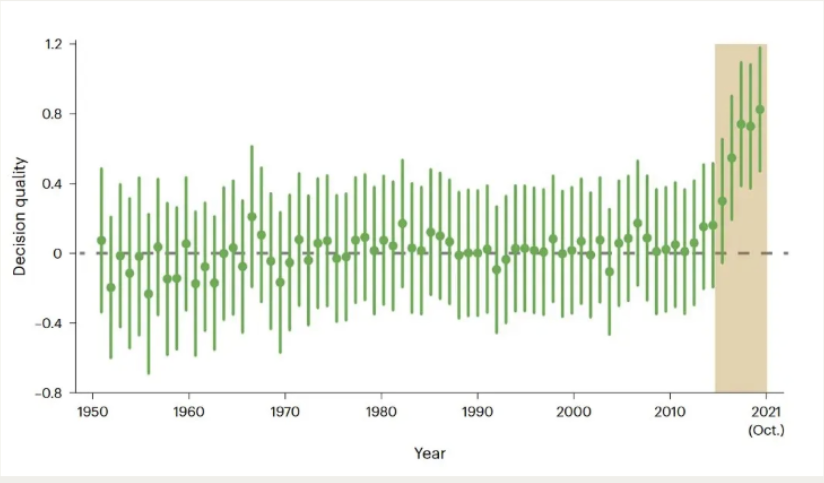
The story is often told as a defeat for humanity. What strikes me is what happened afterwards. In the years following the match, professional Go players became measurably better. An analysis of more than 100,000 games shows that the quality of players' moves rose markedly after AlphaGo – around 40 per cent of the improvement came from AI-inspired moves, the rest from human breakthroughs. The machine did not outcompete the players' creativity. It expanded it.
The question the story raises is the same one I meet in my programmes on AI for creative work: can AI make us more creative? As I see it, the answer depends on what we mean by creativity. Three understandings give three different answers.
Creativity as originality
One understanding sees creativity as the ability to produce something nobody has seen before by combining the familiar in new ways. By that definition, the answer is yes. AlphaGo had neither intentions nor intuition. But its patterns were so alien that they shifted the horizon of the entire game – and the humans followed. None of us can achieve recombination on that scale. What it can do, though, is lend us new starting points we would never have found ourselves.
Creativity as production
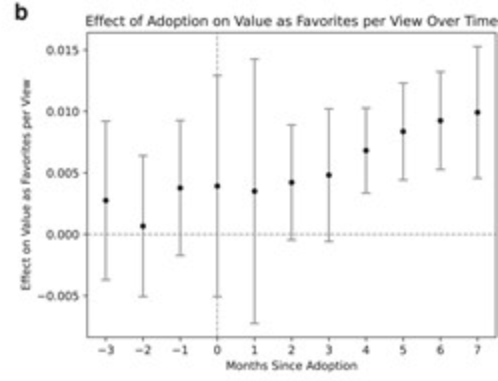
A second understanding measures creativity by what is created: works with aesthetic or other value. Here too, the research points the same way. A study of 4 million works by 53,000 artists on an online art platform showed that the artists' output rose sharply when they adopted image generation – and that audiences' ratings of the works rose steadily afterwards. The volume did not make the work meaningless. It provided more attempts to choose between, and the choices got better.
Creativity as a social process
The third understanding places creativity between people: in the interplay, in the feedback, in shared experiments. AI is not a social being, and here it cannot take part. But it can change the conditions. A sparring partner who never rolls their eyes makes it cheaper to suggest something half-finished. And the half-finished is often where ideas start.
Three answers, one human
So whether AI makes us more creative depends on what we are asking. As originality: yes, it can expand the horizon. As production: yes, it can increase both quantity and quality. As a social process: it cannot take part, but it can lower the threshold for trying. What the three answers have in common is that the human stays in the equation. Intention, interpretation and choice still rest with us – I have written about why that is crucial in the article on when creativity loses its sender.
Three questions are worth taking home: which concept of creativity do you yourselves work from? Where in your process would more attempts make you wiser – and where would they just make you faster? And who chooses once the machine has made its suggestions?
Lee Sedol retired from professional Go in 2019. The players who came after him play better than anyone did before the machine. It won the match. The game grew larger.
Sources
- Shin, M., Kim, J., van Opheusden, B. & Griffiths, T.L.: »Superhuman artificial intelligence can improve human decision-making«, PNAS (2023) – analysis of more than 100,000 professional Go games after AlphaGo.
- Zhou, E. & Lee, D.: »Generative AI, human creativity, and art«, PNAS Nexus (2024) – analysis of 4 million works by 53,000 artists on an online art platform.